How to Heal Your Gut: 5 Steps for Success

You’ve heard about leaky gut syndrome: that it literally means your gut is leaking some of its contents into your body, that a loosening of the tight junctions of the gut lining could cause a host of problems, that it can be a chronic issue, and that it’s bad for more than just your gut health. Maybe you suspect you have it, due to your irritable bowel symptoms, food sensitivities, brain fog, and skin issues. Maybe you’ve seen separate doctors for each of these things, only to realize that none of them really have any answers.
While we never advocate foregoing the doctor when you’re feeling sick, sometimes medical specialists only see the problem from the frames of their own specialties. A dermatologist who doesn’t know a lot about the gut-skin axis might not think to suggest dietary or lifestyle changes to help clear up your acne, eczema, or rosacea. A mental health professional likely won’t consider the gut-brain connection and recommend similar changes to help you with your anxiety, depression, or insomnia.
Rather than foregoing the doctor altogether, consider visiting a functional medicine doctor, who will look at the whole picture to address the root cause of your problems. In many cases, the central issue is the same: a leaky gut. While leaky gut is still a pretty murky medical area (a lot of research still needs to be done), we know there are a few key steps that may help reduce your symptoms. It’s time to learn how to support your digestive system by making a few critical changes. We’ve outlined the steps below.
Step 1: Understand the Basics, Start to Finish
Your digestive process begins with your nose (smelling foods actually gets your digestive juices flowing) and ends with…well, you know where it ends. Addressing your leaky gut starts at the beginning and follows your food bolus all the way through the process. You want to give your body the best chance possible to fully digest your food, assimilate what’s needed, and move out the rest.
Upper Digestion
After the scent of your food comes the taste. With tasting comes chewing, and while chewing seems like a pretty basic thing everyone knows how to do, most people don’t chew their food enough, leaving their stomach acids and digestive enzymes to work overtime once the food moves from the mouth down into the stomach. Improperly chewed food can lead to digestive issues like GERD (gastroesophageal reflux disease), heartburn, bloat, and gas.
So start with chewing your food well. Not only does this make the digestive process easier, it also forces you to slow down and focus on your food, an approach called mindful eating. Mindfulness not only helps your body stay focused on digestion while you’re eating, it also improves your overall sense of well-being and reduces stress, which we’ll address again as it relates to a leaky gut later in this post (1).
Lower Digestion
The lower area of your digestive system includes your small intestine and large intestine. The lower (and largest) section of your bowel is a key part of your overall immune system, so when things start to go wrong, so too can your immune health. This is why so many holistically minded medical professionals associate autoimmune disease, food allergies, and food sensitivities with leaky gut. Put simply, when your intestines aren’t healthy, neither is your immune system.
Your small intestine is where you absorb about 80 percent of your nutrients and where the bulk of the digestive process takes place. Necessarily, this means that at least some microscopic particles should be penetrating the gut wall and entering the bloodstream. Otherwise, you’d die of starvation.
But problems arise when the small intestine becomes hyperpermeable. Although there’s still a lot more work to be done to fully understand exactly what causes autoimmune diseases like Crohn’s disease and celiac disease, many GI specialists suspect that this intestinal permeability has a lot to do with it (2). The question is what came first, the autoimmune disease or the leaky gut? We’ll address that in the next section .
The large intestine is the host of the vast majority of gut bacteria. While it’s not quite as simple as labeling bad and good bacteria, the simplest way to think about your large intestine (your colon) is to know that healthy humans are able to strike a balance among the various microbes that live in your large bowel.
Genetics and early development almost certainly play a role in how susceptible you are to gut dysbiosis (an imbalance of the microbes), but a diet rich in colorful vegetables, fermented foods, healthy fats, and organic meats can help balance the flora by feeding beneficial strains in your gut. You might also consider a probiotic supplement.
Step 2: Reduce Inflammation
Inflammation is a naturally occurring immune response that is meant to protect us from invading bacteria, viruses, and other pathogenic substances. In healthy individuals, the inflammatory response turns on in the face of a threat (like the flu) to protect us, then turns it off again when the threat is gone.
Chronic inflammation, a state in which the body can’t properly turn off the inflammatory response, can heat up the immune system to the point that it begins attacking friendly cells (your own human cells, or the cells from innocuous foods like tree nuts, dairy, or gluten). Some experts argue that this process is linked to a leaky gut, but again, it’s not clear whether the leaky gut causes the inflammation or the inflammation causes the leaky gut. Likely, it’s both, creating a vicious circle that’s difficult to break (3).
We know that an anti-inflammatory diet can help quell chronic inflammation and that inflammation is linked hyperimmunity and digestive issues like small intestinal bacterial overgrowth (SIBO) and inflammatory bowel disease (IBD). So replacing pro-inflammatory foods for anti-inflammatory foods and supplements (like fish oil or turmeric) is a great first step in reducing your overall inflammatory response.
Pro-inflammatory foods include:
- Trans fats (partially hydrogenated oils, often found in processed foods and commercial foods)
- Omega–6 fatty acids (vegetable oil, canola oil, soybean oil, and most seed oils)
- Alcohol
- Foods high in refined carbohydrates and sugars (french fries, crackers, chips, white pasta, white bread, and sweets)
- Conventional dairy and meats
Anti-inflammatory foods include:
- Berries
- Fatty fish
- Broccoli
- Avocados
- Green tea
- Peppers
- Mushrooms
- Grapes
- Turmeric
- Extra virgin olive oil
- Coconut oil and ghee
- Dark chocolate and cacao
- Tomatoes
- Cherries (4)
Check out our post on easy-to-digest foods.
Step 3: Support the Digestive System
Whether or not certain foods and supplements can actually promote gut healing is still hotly debated by the scientific and medical community, but there are a few things we know for sure.
First, as we mentioned before, reducing inflammation is always a good thing when it comes to a healthy gut. Feeding the good gut bacteria with fiber rich foods, in addition to supplementing with fermented foods or probiotic supplements, not only helps lower blood sugar and blood pressure, it also balances the gut flora — preventing the bad bacteria from causing further irritation and inflammation to the digestive tract and other inflamed areas of the body (5).
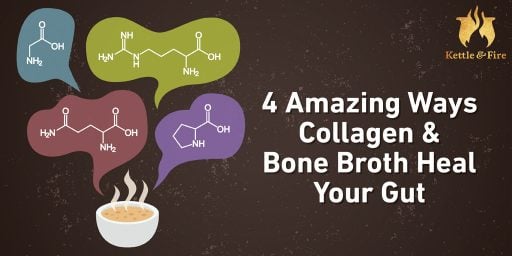
Nutrition experts speculate that functional foods like bone broth, which are rich in amino acids like l-glutamine, proline, and glycine, also contribute by providing the building blocks of protein to tighten the junctions in the intestines. However, more research needs to be done to back up this claim (2).
That being said, a quick Google search will reveal a pile of anecdotal evidence to support the idea that bone broth may help the gut. You can read some of our testimonials here.
Step 4: Break the Stress Cycle
As promised, this is the section where we’ll revisit mindfulness. Study after study connects chronic stress with digestive issues, including nausea, vomiting, constipation, diarrhea, and low stomach acid, just to name a few (6). We know that at least some cases of SIBO are caused by low stomach acid or slow motility, and that at least some cases of leaky gut are caused by SIBO. But we also know that life’s stressors aren’t going anywhere. What to do?
Find something that works for you to help you cope with the unavoidable stressors in life. We mentioned mindfulness because it’s among the simplest ways to get started in a stress reduction practice, and you can start your practice right at your kitchen table with mindful eating.
Mindful eating involves just a few things: you, your food, and a table. Notice that we didn’t say your car, your couch, or your TV. Mindful eating is the act of sitting and focusing on your food, taking one slow bite at a time, noticing the change in textures, the flavors, the smells, the colors, and then swallowing. Some perform this by putting their fork down between bites. This type of practice not only slows down your mind, but it also helps your body focus on the task at hand: digesting your food (7).
More broadly, a mindfulness meditation practice will help you gain perspective and live in the here and now. It helps you to observe passively without judgment (8).
Finding just a few brief minutes each day (at first it can be as few as two minutes) to sit with a mindfulness practice can help you clear your head and get to the important tasks in life. It can also improve your sleep, which is another important part of healing your gut. There are tons of free and inexpensive meditation apps and YouTube videos available to help you take the first step toward your new practice.
Step 5: Get Some Rest
High quality sleep is incredibly good for you. Poor sleep can lead to weight gain, a shift in the gut microbiome, brain fog, poor recall, and changes in memory and cognition (9). The gut-sleep connection is a feedback loop in which good or poor sleep can affect the microbiome, and a balanced or imbalanced microbiome can affect the gut. A large percentage of the body’s serotonin production takes place in the gut, and serotonin is a precursor to melatonin, the hormone that helps regulate your circadian rhythm (sleep cycles) (10).
While there’s still much left to be understood about the function of sleep, we know that good sleep hygiene leads to better quality sleep. Good sleep hygiene involves consistently sleeping and waking at the same times every day, reducing screen time at night, having a consistent bedtime ritual, and intentionally winding down at least an hour before bedtime. These practices will make it a lot more likely that you get consistent ZZZs each night and contribute to your overall gut health.
No One Said It Would Be Easy
We understand that we’ve just thrown a lot of information at you, most of which likely requires making some substantial changes on your part. Take this list one thing at at time rather than attempting to do everything at once. We would wager that attempting to make all of these changes at once would not only be a huge challenge, it might make step 4 (reducing your stress) close to impossible.
Choose a step in the process to start with, ideally the one you think would be easiest, and start there. And see if you can find a holistic medical professional to work with to help you along the way, whether it’s a functional medicine doctor, a naturopathic doctor, or even an herbalist or acupuncturist to help you get on track.
Pin for later: